Kolkata, also known as Calcutta, is the capital and largest city of the Indian state of West Bengal. It lies on the eastern bank of the Hooghly River, 80 km (50 mi) west of the border with Bangladesh. It is the primary financial and commercial centre of eastern India and one of the gateways to northeastern India. Kolkata is the seventh most populous city in India with an estimated city proper population of 4.5 million while its metropolitan region Kolkata Metropolitan Area is the third most populous metropolitan region of India with a metro population of over 15 million. Kolkata is regarded by many sources as the cultural capital of India and a historically and culturally significant city in the historic region of Bengal.
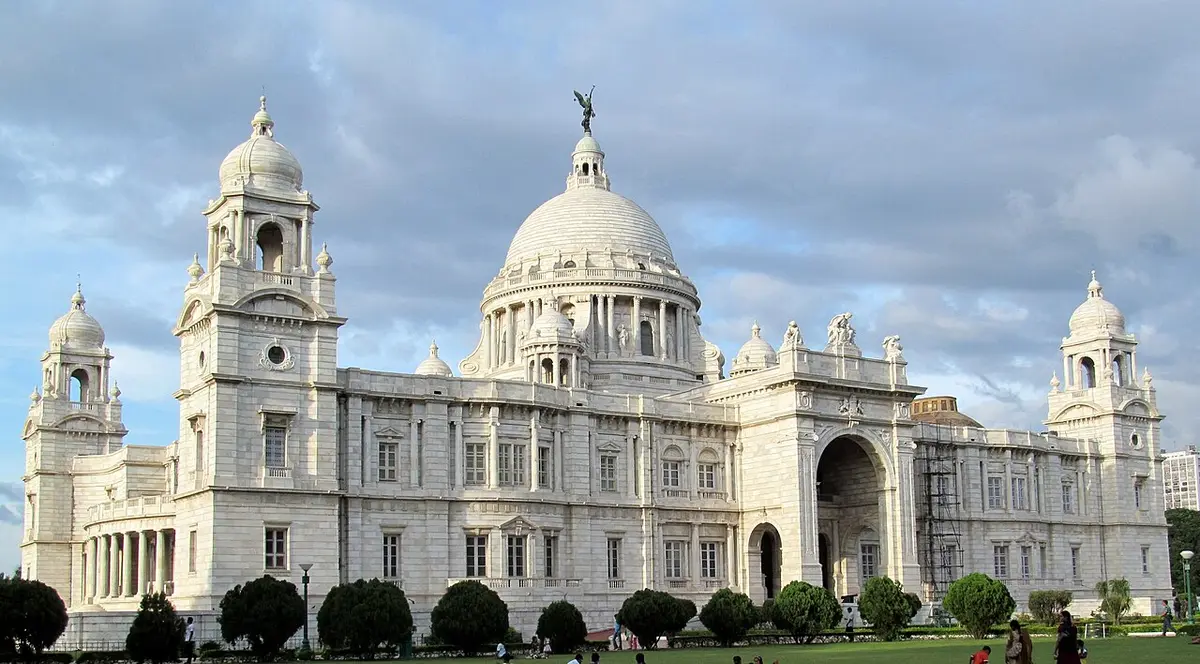
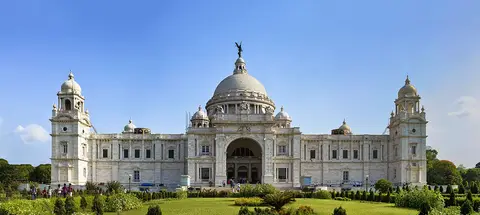
The Victoria Memorial is a large marble monument in the Maidan in Central Kolkata (Calcutta), having its entrance on the Queen's Way. It was built between 1906 and 1921 by the British Raj. It is dedicated to the memory of Queen Victoria, the Empress of India from 1876 to 1901.
The work of construction was entrusted to Martin & Co. of Calcutta founded by Rajendranath Mukherjee and Thomas Acquin Martin, and work on the superstructure began in 1910.
It is the largest monument to a monarch anywhere in the world. It stands at 26 hectares of gardens and is now a museum under the control of the Ministry of Culture, Government of India. Possessing prominent features of the Indo-Saracenic architecture, it has evolved into one of the most popular attractions in the city.
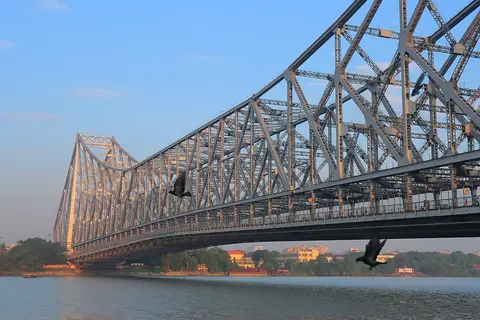
The Howrah Bridge is a balanced steel bridge over the Hooghly River in West Bengal, India. Commissioned in 1943, the bridge was originally named the New Howrah Bridge, because it replaced a pontoon bridge at the same location linking both sides of Kolkata. Burrabazar is connected with Howrah rail terminal because of this bridge. On 14 June 1965, it was renamed Rabindra Setu after the Bengali poet Rabindranath Tagore, who was the first Indian and Asian Nobel laureate. It is still popularly known as the Howrah Bridge.
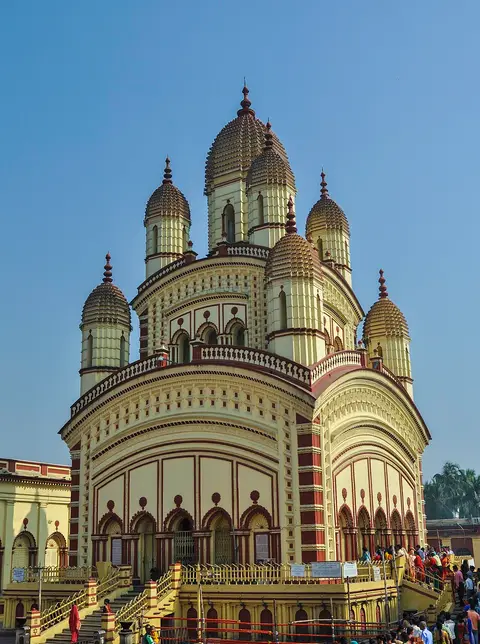
Dakshineswar Kali Temple is a Hindu navaratna style temple in Dakshineswar, Kolkata, West Bengal, India, on the eastern bank of the Hooghly River. The presiding deity of the temple is Bhavatarini (Kali), a form of Mahadevi or Parashakti Adya Kali, otherwise known as Adishakti Kalika. The temple was built in 1855 by Rani Rashmoni, a zamindar of the Janbazar Raj, and a devotee of Kali. The temple is associated with Ramakrishna and Sarada Devi, his wife and devotee mystic, both of 19th century Bengal.
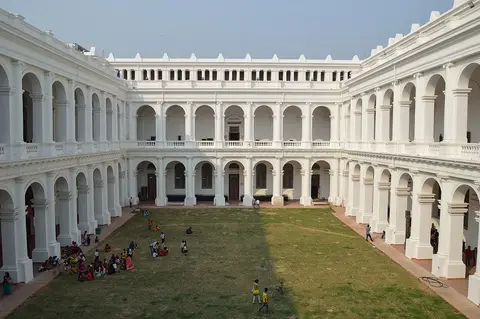
The Indian Museum is a grand museum in Central Kolkata, West Bengal, India. It is the ninth oldest museum in the world and the oldest, as well as the largest museum in Asia, by size of collection. It has rare collections of antiques, armour and ornaments, fossils, skeletons, mummies and Mughal paintings. It was founded by the Asiatic Society of Bengal in Kolkata (Calcutta), India, in 1814. The founder curator was Nathaniel Wallich, a Danish botanist.
 Sawadeeka