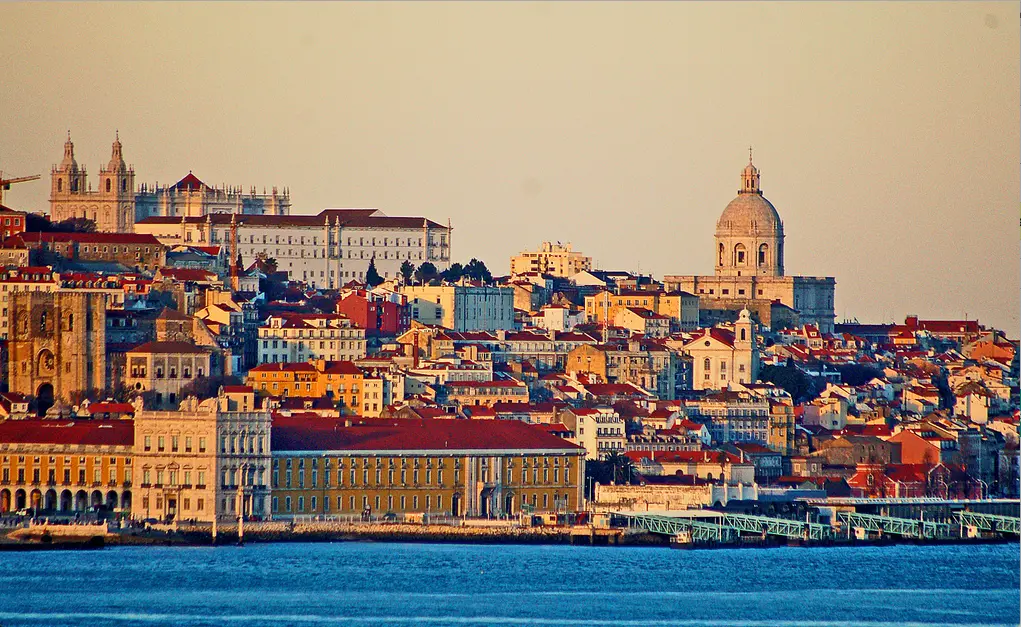
Lisbon is the capital and most populous city of Portugal, with an estimated population of 658,236 as of 2025, within its administrative limits and 3,353,000 within the metropolis, as of 2025. The city lies in the western part of the Iberian Peninsula, fronting the northern shore of the River Tagus.
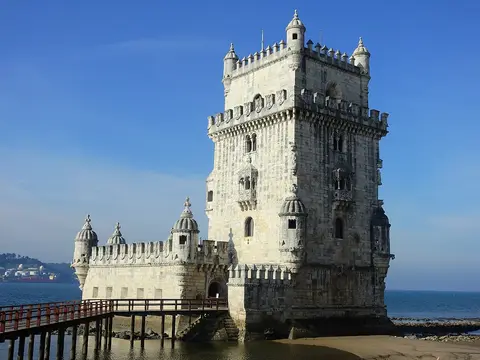
Belém Tower, officially the Tower of Saint Vincent, is a 16th-century fortification located in Lisbon, Portugal, which served as a point of embarkation and disembarkation for Portuguese explorers and as a ceremonial gateway to Lisbon. The tower symbolizes Portugal's maritime and colonial power in early modern Europe. It was built during the height of the Portuguese Renaissance and is a prominent example of the Portuguese Manueline style, but it also incorporates other architectural styles, such as the minarets, which are inspired by Moorish architecture. The structure was built from lioz limestone, a material local to the Lisbon region, and is composed of a bastion and a 30-metre (100 ft) four-storey tower.
Building in Santa Maria de Belém, Lisbon District, Portugal
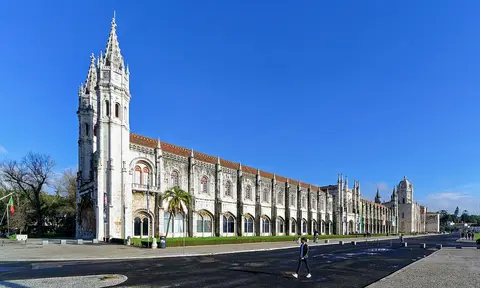
The Jerónimos Monastery or Hieronymites Monastery is a former monastery of the Order of Saint Jerome near the Tagus river in the parish of Belém, in the Lisbon Municipality, Portugal. It became the necropolis of the Portuguese royal dynasty of Aviz in the 16th century but was secularized on 28 December 1833 by state decree and its ownership transferred to the charitable institution, Real Casa Pia de Lisboa.
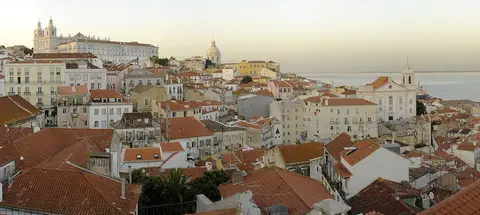
The Alfama is the oldest neighborhood of Lisbon, spreading on the slope between the São Jorge Castle and the Tagus river. The district includes the freguesias (parishes) of São Miguel, Santo Estêvão, São Vicente de Fora and part of the two streets, "Freguesia da Sé: Rua do Barão" and "Rua São João da Praça". It contains many important historical attractions, as well as an abundance of Fado bars and restaurants.
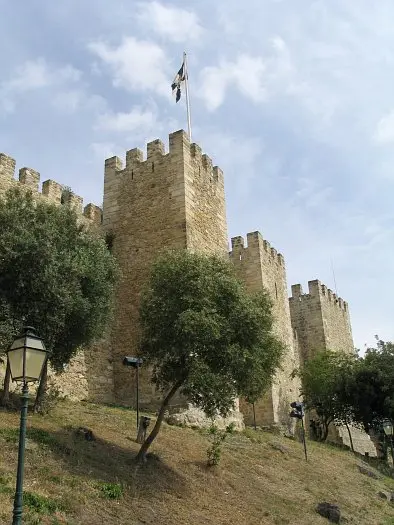
São Jorge Castle, sometimes known in English as Saint George's Castle, is a historic castle in the Portuguese capital of Lisbon, located in the freguesia of Santa Maria Maior. Human occupation of the castle hill dates to at least the 8th century BC while the oldest fortifications on the site date from the 2nd century BC. The hill on which Saint George's Castle stands has played an important part in the history of Lisbon, having served as the location of fortifications occupied successively by Phoenicians, Carthaginians, Romans, and Moors, before its conquest by the Portuguese in the 1147 Siege of Lisbon. Since the 12th century, the castle has variously served as a royal palace, a military barracks, home of the Torre do Tombo National Archive, and now as a national monument and museum.