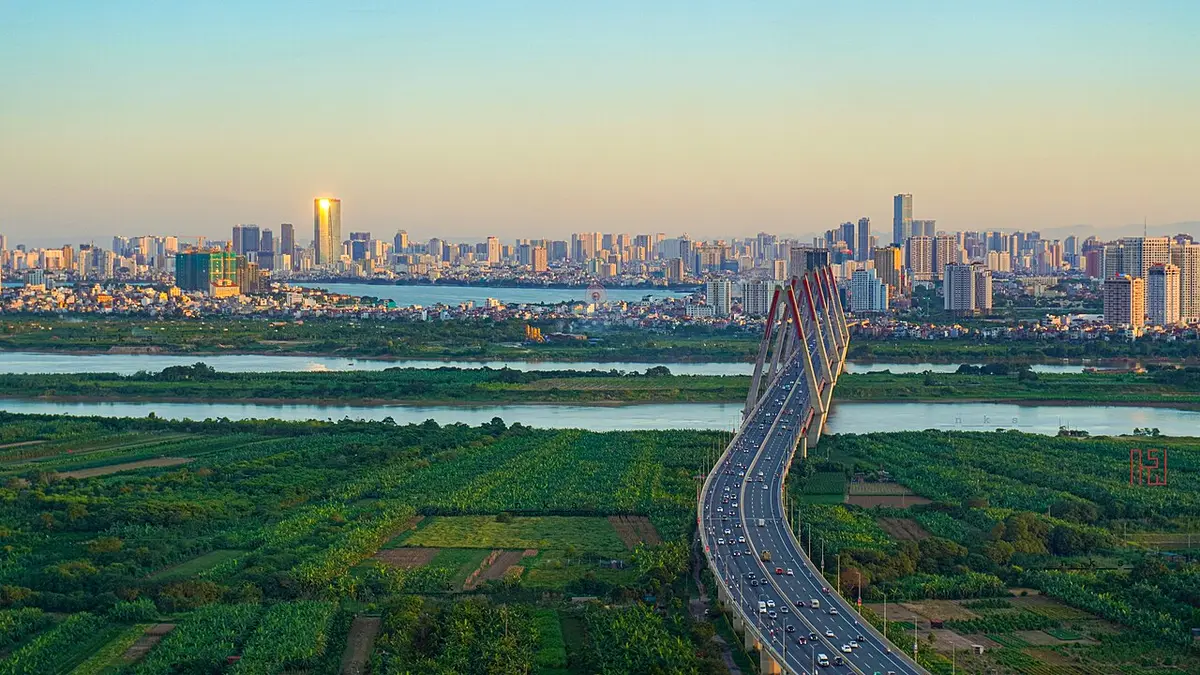
Hanoi is the capital and second-most populous centrally-governed city of Vietnam. It covers an area of 3,358.6 km2 (1,296.8 mi2), and as of 2026 has a population of 8.7 million. Hanoi had the second-highest gross regional domestic product of all Vietnamese provinces and centrally-governed cities at US$48 billion in 2023, behind Ho Chi Minh City. It hosts 83 foreign embassies, the headquarters of the Vietnam People's Army (VPA), its Vietnam National University system, and other governmental organizations. Hanoi had 18.7 million domestic and international visitors in 2022. It hosts the Imperial Citadel of Thăng Long, Ho Chi Minh Mausoleum, Hoàn Kiếm Lake, West Lake, and Ba Vì National Park near the outskirts of the municipality. Hanoi's urban area has architectural styles, including pre-colonial Vietnamese architecture, French colonial architecture, brutalist apartments and disorganized alleys and tube houses stemming from the city's growth in the 20th century.
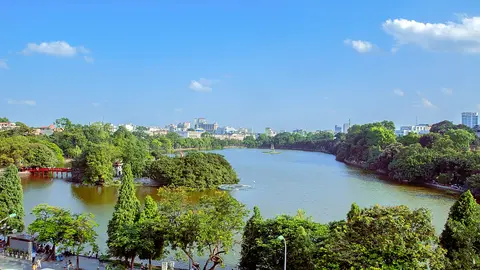
Hoàn Kiếm Lake, also known as Sword Lake or Tả Vọng Lake, is a fresh water lake, measuring some 12 ha in the historical center of Hanoi, the capital city of Vietnam.
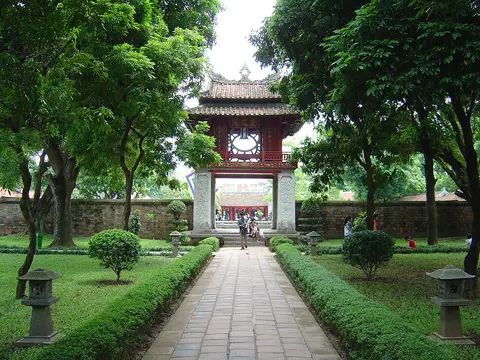
Văn Miếu, literally translated as Temple of Literature, is a temple dedicated to Confucius in Hanoi, northern Vietnam. The temple was founded and first built in 1070 at the time of Emperor Lý Thánh Tông, and it hosted the Imperial Academy, Vietnam's first national university, from 1076 to 1779. In 1803, The academy was moved to the new capital of Nguyen dynasty in Hue.
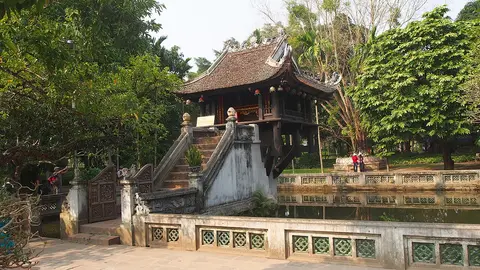
The One Pillar Pagoda, formally belongs to an architecture complex called Diên Hựu tự which means 'pagoda of extended blessings'. The pagoda is a historic Buddhist temple in the central Ba Đình district, Hanoi, the capital of Vietnam. The most famous part of this architecture complex is Liên Hoa Đài (蓮花臺) means 'the lotus pedestal' which is a temple with special structure: a building laid on one pillar. The original pagoda was built in 1049, had some additions and was perfected in 1105. It is regarded alongside the Hương Temple, as one of Vietnam's two most iconic temples.
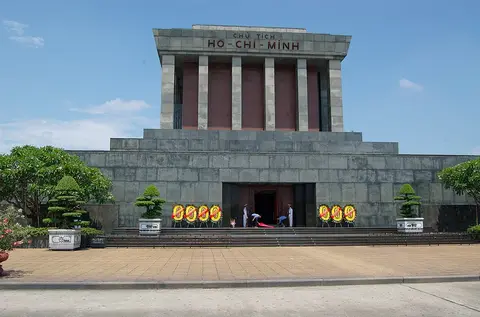
The President Ho Chi Minh Mausoleum is a mausoleum which serves as the resting place of Vietnamese revolutionary leader and President Ho Chi Minh in Hanoi, Vietnam. It is a large building located in the center of Ba Đình Square, where Ho, Chairman of the Workers' Party of Vietnam from 1951 until his death in 1969, read the Declaration of Independence on September 2, 1945, establishing the Democratic Republic of Vietnam. It is open to the public every morning except Monday and Friday.
 Sawadeeka